
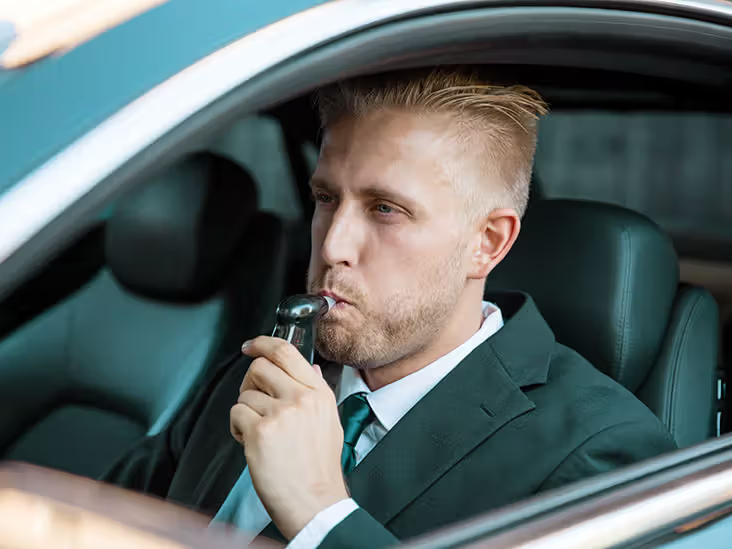

A persistent urban legend circulates among drivers who like to think they understand the legal system: if you get pulled over after having a few drinks, you should flatly refuse the breathalyzer. The logic sounds airtight on the surface. Without a numerical blood alcohol concentration recorded on an official printout, the prosecutor has no hard scientific proof, and without proof, the state cannot secure a conviction.
In practice, that advice is one of the most destructive legal misconceptions an individual can follow.
Refusing a breathalyzer does not function as an automatic escape hatch from a driving under the influence charge. Instead, it unleashes a cascade of immediate civil penalties, triggers independent administrative sanctions against your driving privileges, and often hands the prosecutor a powerful psychological weapon in the courtroom. Deciding whether to blow into a testing device involves a complex intersection of administrative regulations, criminal statutes, and constitutional law that operates very differently from how most people imagine.
The Crucial Distinction Between Roadside and Station Tests
A primary reason drivers get into deep trouble during a traffic stop is that they confuse two entirely different testing devices. Law enforcement officers use two distinct categories of breath tests, and the legal obligations attached to them are not identical.
Portable Breath Tests at the Roadside
The handheld device an officer pulls out of their cruiser during an initial traffic stop is known as a preliminary alcohol screening device or portable breath test.
Officers administer this roadside test while you are standing on the shoulder of the highway, typically alongside standardized field sobriety tests like the horizontal gaze nystagmus, the walk-and-turn, and the one-leg stand. In most states, submitting to this preliminary roadside breath test is voluntary for adult drivers who are not on probation and are over the legal drinking age.
The preliminary test is not designed to produce the final, certified piece of evidence used to prove guilt in court; it is an investigative tool used to help the officer establish probable cause for an arrest. In many jurisdictions, the numerical reading from a handheld roadside device is not even admissible in a criminal trial to prove exact blood alcohol content because the machines are prone to calibration drift and environmental interference. Declining this roadside screening may carry little to no formal penalty under the law, though it rarely prevents an officer who smells alcohol from arresting you anyway.
Evidentiary Chemical Tests Post-Arrest
Everything changes the moment the officer places you in handcuffs and transports you to the police precinct, county jail, or a mobile processing unit.
Once under formal arrest, the officer will instruct you to blow into a desktop infrared spectrometer, commonly referred to by brand names like the Intoxilyzer or DataMaster. This is not a preliminary screen; it is an evidentiary chemical test.
Evidentiary machines are calibrated to state forensic laboratory standards, monitored under strict operating protocols, and administered following a mandatory fifteen-to-twenty-minute continuous observation period to ensure mouth alcohol does not corrupt the reading. This is the official test covered under state statutory frameworks, and refusing this device triggers severe, immediate consequences.
Implied Consent Laws: The Fine Print on Your Driver’s License
Many drivers believe that the Fifth Amendment protects them from being compelled to blow into a breath machine. They argue that providing a breath sample is a form of self-incrimination.
The United States Supreme Court resolved this issue decades ago. The constitutional protection against self-incrimination applies only to testimonial evidence—meaning your words, statements, and confessions. It does not protect physical evidence gathered from your body, such as fingerprints, mugshots, DNA swabs, or the chemical composition of the air expelled from your lungs.
Every state has codified this principle into law through implied consent statutes. Under implied consent, operating a motor vehicle on public roadways is treated as a conditional privilege rather than an unconditional constitutional right. When you signed the paperwork at the Department of Motor Vehicles to obtain your driver’s license, you legally consented in advance to submit to chemical testing whenever a law enforcement officer has lawful probable cause to suspect you are driving while impaired.
You retain the physical power to refuse the test when standing in front of the machine at the station, but you do not possess the legal right to do so without penalty. By withholding your consent, you breach your foundational agreement with the state, which immediately activates a separate, administrative punishment mechanism entirely divorced from whatever happens in a criminal courtroom.
Immediate Administrative Fallout: The Loss of Driving Privileges
The most swift and predictable consequence of refusing an evidentiary breath test is an immediate, automatic driver’s license suspension.
This action is known as an administrative license suspension, and it is enforced directly by the state’s licensing bureau rather than a judge in a criminal court. If you take the test and register a blood alcohol concentration of 0.08 percent or higher, your license will be suspended, but many states allow first-time offenders to petition for a restricted hardship permit relatively quickly. A hardship license allows you to drive to work, medical appointments, school, or childcare.
If you refuse the chemical test, however, state laws impose far harsher administrative penalties:
-
Extended suspension periods. A test refusal typically results in a mandatory license revocation lasting anywhere from six months to a full year for a first offense, and two to three years for a subsequent refusal.
-
Hard suspension rules. Many jurisdictions impose a strict “hard suspension” on test refusers. This means you are completely ineligible for a restricted or conditional work permit for a specified window, often ninety days to a full year. You simply cannot legally drive anywhere, under any circumstances.
-
Heavier reinstatement hurdles. Regaining your driving privileges after a refusal frequently requires paying elevated reinstatement fees, completing extensive substance abuse education programs, and installing a costly ignition interlock device on your vehicle for an extended period once the suspension lapses.
Importantly, this administrative suspension takes effect regardless of what happens in your criminal trial. Even if the prosecutor later dismisses the criminal DUI charge entirely, or a jury finds you not guilty, the administrative revocation for violating the implied consent statute remains firmly in place.
Can You Still Be Convicted of a DUI Without Breath Numbers?
The central myth behind refusing the test is that prosecutors cannot prove a case without a specific decimal point on a piece of paper. This assumption confuses the two statutory methods prosecutors use to secure an impaired driving conviction.
States generally prosecute drunk driving under two distinct legal theories: per se impairment and general impairment.
A per se charge requires the prosecution to prove only one thing: that you operated a motor vehicle with a blood alcohol concentration of 0.08 percent or greater. They do not have to prove that your driving was erratic or that you were slurring your words; the scientific number alone establishes guilt. If you refuse the test, the state cannot charge you under the per se statute.
However, the state can still aggressively prosecute you under the general impairment statute. To win a conviction under this theory, the state only needs to prove that your ability to safely operate a motor vehicle was impaired by alcohol or drugs. Prosecutors do this every day without chemical evidence, relying on a mosaic of circumstantial proof:
-
The initial driving conduct that justified the stop, such as weaving across lane markers, driving without headlights, or braking erratically.
-
Physical observations made by the arresting officer, including bloodshot and watery eyes, the smell of alcohol on your breath, flushed skin, or fumbling while retrieving registration documents.
-
Performance on roadside physical agility exercises, which officers document meticulously.
-
Video recordings from police cruiser dash cameras, officer body-worn cameras, and processing room surveillance.
Jurors watching body camera footage of a defendant leaning against a patrol car for balance or struggling through basic instructions do not need a laboratory printout to conclude beyond a reasonable doubt that the driver was intoxicated.
The Damaging Power of Consciousness of Guilt
Beyond relying on physical and circumstantial observations, prosecutors turn the refusal itself into a central piece of evidence against you.
In the vast majority of jurisdictions, state law explicitly permits the prosecution to introduce your refusal into evidence during the trial. The prosecutor is allowed to frame your refusal around a legal doctrine known as consciousness of guilt.
During closing arguments, the prosecutor will look directly at the jury and make a straightforward, intuitive argument: an innocent, sober motorist who is falsely accused of driving drunk would eagerly blow into the machine to clear their name and go home. The only reason someone refuses a simple, painless breath test is that they knew they were intoxicated and knew the machine would prove it.
Juries find this argument compelling. For many jurors, a flat refusal appears far more damning than a borderline chemical reading of 0.08 or 0.09 percent, which an experienced defense attorney could potentially challenge by scrutinizing machine calibration logs or metabolic rates.
The Rise of Expedited Warrants and Forced Blood Draws
Drivers who think a refusal ends the state’s chemical inquiry are often shocked by what happens next. In an era of digital communication and expedited judicial processing, refusing a breath test does not necessarily prevent the police from getting your biological data; it merely changes the method of collection.
Law enforcement agencies increasingly utilize electronic search warrant systems. If an arrestee refuses the desktop breathalyzer, the arresting officer can draft a concise affidavit, transmit it electronically to an on-call magistrate or judge, and receive a signed search warrant authorizing a chemical draw within fifteen to thirty minutes. Many jurisdictions run dedicated “no-refusal” enforcement periods on holiday weekends, stationing phlebotomists and magistrates directly inside booking facilities.
Once a judge signs a search warrant, providing a sample is no longer optional. Medical personnel at a hospital or detention facility will draw your blood, using reasonable physical restraint if you resist.
When this happens, the strategy of refusing the breathalyzer backfires completely. You will still have your blood tested for alcohol and drugs, providing the state with its chemical evidence—often with greater forensic precision than a breath test offers. Simultaneously, you will remain saddled with all the administrative penalties, license revocations, and evidentiary drawbacks of having formally refused the breath test in the first place.
When States Treat Refusal as a Separate Crime
While many states treat an implied consent refusal strictly as an administrative violation punished through license revocation, a growing number of states have escalated the consequences into the criminal realm.
In some jurisdictions, the act of refusing a chemical test after a lawful DUI arrest is an independent criminal offense. Under these statutory schemes, you can be found not guilty of driving under the influence and still be convicted of criminal refusal, resulting in fines, mandatory community service, probation, and even mandatory minimum jail terms.
In states where refusal is not an independent crime, it is frequently classified as a statutory sentencing enhancement. If you are convicted of DUI after refusing the test, state law may mandate higher statutory fines, longer mandatory minimum jail sentences, and compulsory installation of an ignition interlock device compared to a defendant who cooperated with chemical testing.
How Defense Attorneys Approach the Refusal Dilemma
Criminal defense attorneys view breath test refusals with mixed feelings. While a refusal deprives the state of a tidy numerical calculation, it strips away many of the most effective technical defense strategies while introducing harsh administrative roadblocks for the client.
When a driver submits to a breath test, an experienced attorney has concrete targets to attack. They can subpoena maintenance histories, check when the simulator solution was last changed, scrutinize the operator’s certification credentials, and review the machine’s internal diagnostic logs for software errors. If the reading is close to the legal threshold, an attorney can argue margin of error or explore the physiology of rising blood alcohol, demonstrating that the driver was below the legal limit while behind the wheel and only rose above 0.08 percent later at the precinct.
With a refusal, those technical defenses disappear. The trial pivots entirely to the subjective narrative of the arresting officer and the visual impression made by body camera footage. Furthermore, prosecutors are far less inclined to offer favorable plea bargains—such as reducing a DUI charge to reckless driving—to defendants who refused chemical testing, partly because statutory rules often forbid diversion programs for non-compliant drivers.
The notion that you can outsmart a drunk driving arrest by refusing to blow into a breathalyzer is a dangerous legal fallacy. While declining a preliminary roadside test can sometimes limit an officer’s pre-arrest evidence gathering, refusing an evidentiary chemical test after an arrest almost always compounds your legal jeopardy. Between immediate license revocations, the prospect of an electronic warrant for a forced blood draw, and the heavy weight juries place on a refusal, saying no to the machine rarely delivers the clean escape drivers hope for.
